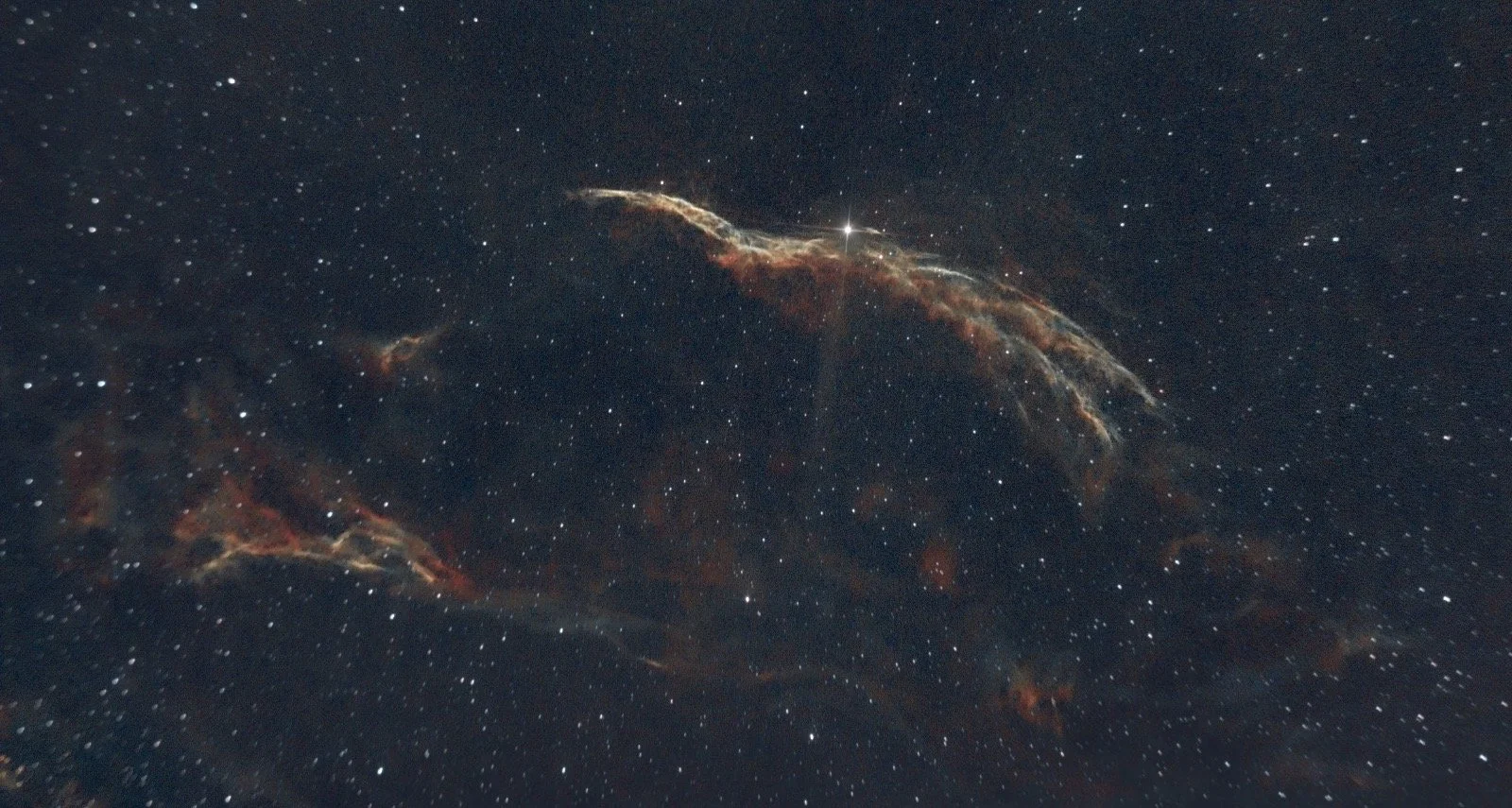
WESTERN veil nebula
When you live under Bortle 7 skies that are washed-out by light pollution and buzzing with suburban glow, it sometimes feels like the universe is just out of reach. But last night, armed with a Nikon D750, my trusty 5-inch Newtonian, and the rock-solid Sky-Watcher HEQ-5 Pro, I set out to prove otherwise.
I’ve always been drawn to the Veil Nebula complex, especially the Western Veil, also known as the Witch’s Broom. Its sweeping threads of ionized gas and sharp tendrils of glowing hydrogen look like an interstellar brushstroke. But challenges like these are what make the hobby worthwhile.
By 9 PM, I was polar aligned, balanced, and guiding. The unmodded Nikon D750 was riding behind the 5" f/5 Newtonian. The HEQ-5 Pro handled the tracking beautifully, even without guiding it handled 2 minute exposures perfectly,
I used a UHC to cut through most of the urban light glow. That was the key. Without it, the target would’ve been swallowed by the yellow soup of light pollution.
I shot 2 minute subs at ISO 1200 totaling about 2.5 hours over the course of the night. I had to toss a few frames due to airplanes and street lights, but that’s life under Bortle 7. After calibration and stacking in Siril, I started to process and slowly teased out the details and reduced the stars.
The result? Surprisingly good. The Veil’s delicate arcs emerged from the blackness, subtle but definitely there. With enough stretching and careful masking, the blues and reds began to separate, and the filamentary structure revealed itself.
Astrophotography from a light-polluted area isn't impossible, it just requires a bit more patience, planning, and post-processing. Having solid gear makes a huge difference, too. The D750’s dynamic range helped preserve detail, and the HEQ-5 Pro tracked like a champ all night.
Most of all, it reminded me that you don’t have to drive to a Bortle 2 site to connect with the cosmos. Sometimes, with the right tools and a bit of determination, the universe comes to you, even in the glow of the city.