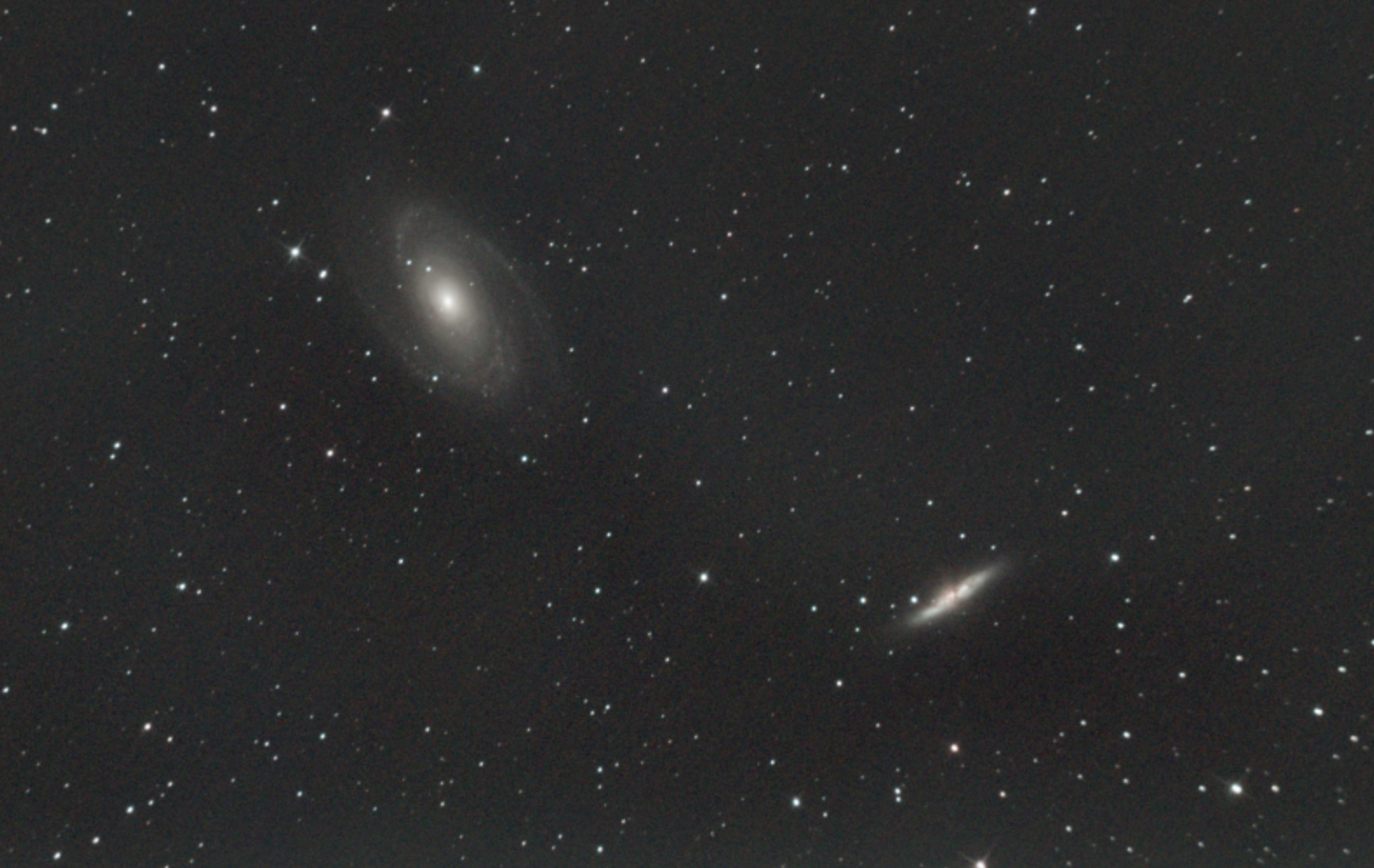
Bode and cigar galaxy
Last night was one of those rare evenings where everything lined up just enough to make an imaging session possible. No major weather surprises, no equipment malfunctions, and, most importantly, no moon. I didn’t have access to a dark site, but sometimes that’s the beauty of astrophotography, you work with what you’ve got. And what I had was a backyard nestled under a Bortle 7 suburban sky, my HEQ-5 mount, a 5-inch Newtonian, and my trusty Nikon D750.
I started setting up just after sunset. The air was cool but not uncomfortable, as are most springtime nights. The scope, a 130mm f/5 reflector, feels just right for nights like this. Nothing too fancy, but with good collimation and a stable mount, it punches well above its weight. I’ve been using the HEQ-5 for a while now and it’s always delivered solid tracking. I polar-aligned using the built-in polar scope. Once the mount was dialed in, I fired up my mount slewed over to the targets of the night, Bode’s Galaxy and the Cigar Galaxy, M81 and M82.
They were high in the northern sky, well positioned to avoid the worst of the local light dome. From here, surrounded by streetlights and porch bulbs and all the usual suburban skyglow, I knew I wouldn’t be seeing them until I get a few minutes of exposures in. But that’s part of the thrill, knowing something that distant, that ancient, is still within reach with the right tools.
I ran a quick test shot to dial in the focus, and then set up for 2 minute exposures at ISO 1000. That seemed like the sweet spot for balancing signal and noise with this setup, especially given how bright these two galaxies are. Over the next few hours, I watched the subs roll in, one after another. These are galaxies that have been interacting for millions of years, caught in the gravitational pull of each other, and here I was capturing them from the comfort of my backyard with a camera most people have just laying around.
By the end of the session, I had about 2 and a half hours of integration time. I packed it in around 1 AM, feeling that mix of satisfaction and curiosity that always comes at the end of a clear night. The data looked promising, sharp stars, plenty of signal, not too much satellite interference, and once I brought it into Siril to bring the image to life.
After background extraction and some careful stretching, the structure of both galaxies stood out clearly. M81’s soft spiral arms and bright nucleus contrasted beautifully with M82’s core. With some color balancing and final tweaks, the image turned out better than I expected, even with all the noise that comes with an uncooled DSLR camera especially considering the conditions.
It’s easy to get caught up in the idea that you need pristine dark skies to do real astrophotography. And sure, dark sites make everything easier. But nights like this prove that you can still pull in deep space, even from the glow of the suburbs. With enough patience, practice, and a little bit of love for the process, galaxies eleven million light-years away can land on your sensor like friends coming by for a visit.
I think next time I’ll try for the Leo Triplet or maybe even push for some fainter fuzzies in Virgo. But for now, I’ll sit back, enjoy this image, and remind myself that you don’t always have to leave home to touch the stars.