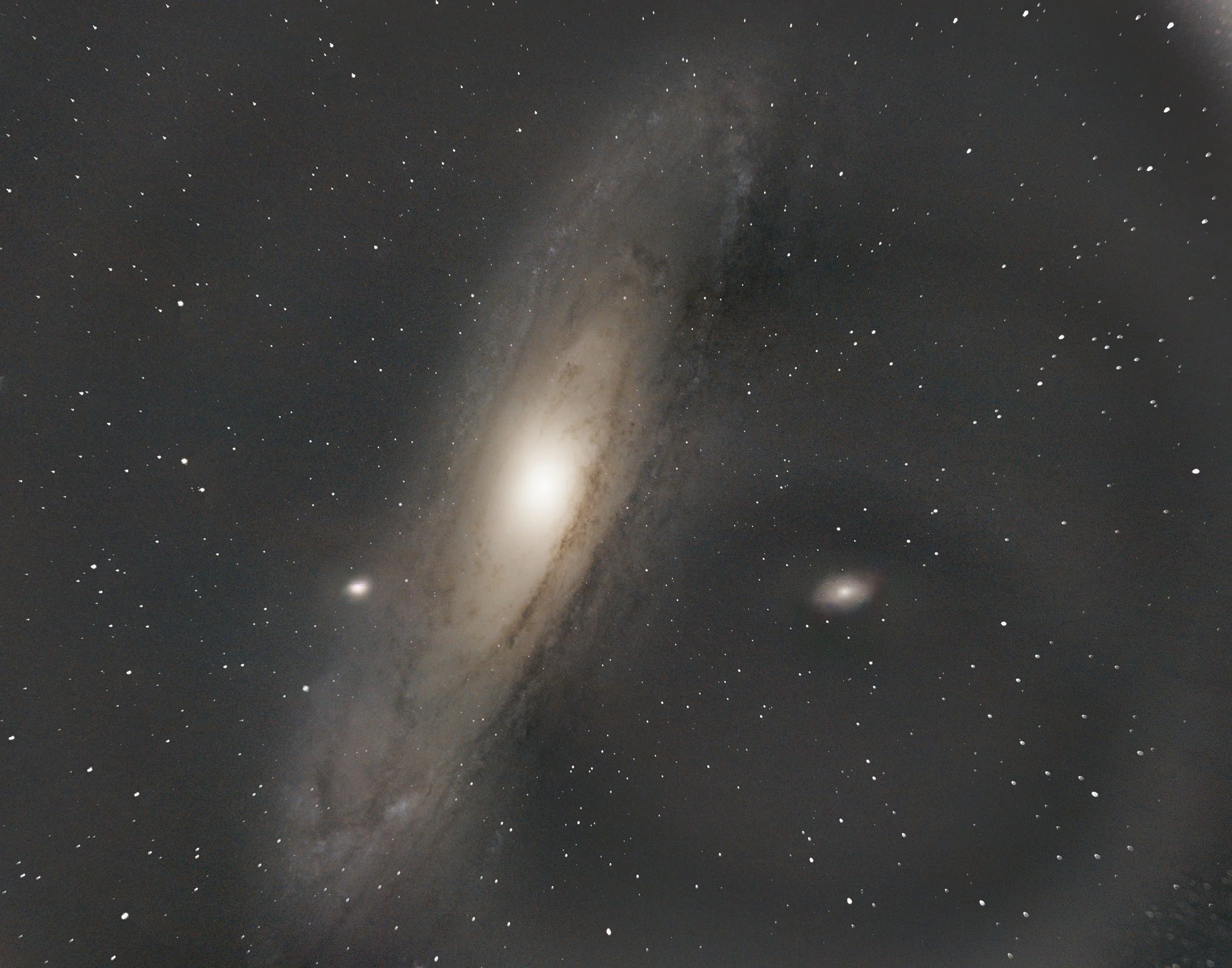
Andromeda Galaxy
Last night, under my Bortle 7 suburban skies, I tried to image the Andromeda Galaxy (M31) using my modest but trusty setup, a Nikon D750 DSLR, a 5-inch Newtonian reflector, and my Sky-Watcher HEQ-5 Pro mount. The Nikon D750 has a full-frame sensor, so it pairs nicely with my Newtonian's relatively wide field of view. Attaching it solidly to the HEQ-5 Pro, I knew I could trust the tracking to stay steady while I built up the light from Andromeda, even when I did have to fight through the skyglow in my suburbs.
Polar alignment was a bit of a patience issue, porch lights and streetlights aren't exactly great considering where I am the North Star comes right above my neighbors house, but once I had it dialed in, guiding was silky enough to allow for longer exposures without excessive trailing.
On darker skies, Andromeda stands out with incredible contrast. But under Bortle 7, the galaxy is faint, trying to break through the shroud of light pollution. I could not rely solely on exposure time, without a light pollution filter, since the background turns white right away. Therefore, I shot a series of shorter exposures, around 60–90 seconds each, and planned to stack later in post-processing.
Even in the first test shot, Andromeda's glowing core burst into sight, with suggestions of its sweeping arms. Seeing that familiar oval form on my Nikon LCD screen startled me with joy. It is hard to put into words, the knowledge that those photons had traveled over 2.5 million years just to land at their last stop on my camera sensor is mind-boggling.
Once I'd accumulated a few hours of data, as well as darks, flats, and bias frames, I processed all of it using stack software. That's where the magic truly came alive: the ghostly dust lanes came into focus, the star cloud M110 penetrated, and even some of the faint blue hues in the spiral arms made an appearance. With some gentle stretching and noise reduction, Andromeda emerged in all its glory, despite my suburban skies.
What I love about astrophotography is that it always weighs the balance towards challenge with reward. Yes, I was struggling against light pollution, but the result still involved a glimpse into a local galaxy. My 5-inch Newtonian and Nikon D750 aren't exactly high-end gear, but they once again proved that patience and technique can pull something amazing out of almost anywhere.